Solar blindness is achieved with a three‑stage filter chain in the receiver, matched to the stabilized laser wavelength:
- Interference pre‑filter Commercial filter, FWHM ~1 nm, >90 % transmission at the lidar wavelength, blocking of the rest of the spectrum >OD6.
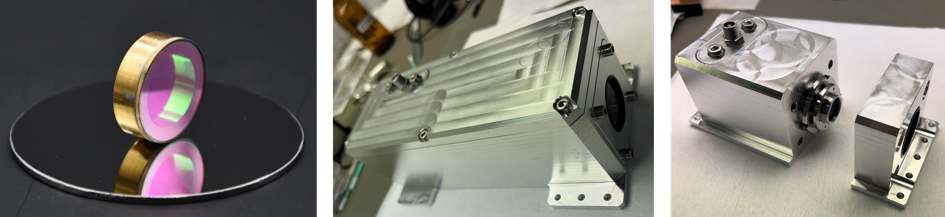
- Solid etalon (plane‑parallel) High‑finesse substrate with ≈1 pm FWHM, temperature‑stabilized (better than 1/1000 K) to act as a narrowband reference. A novel soldering technique mounts the thin substrate face‑down to a metallic ring, providing excellent thermal contact and long‑term stability without mechanical stress. Transmission and finesse in IR and UV are within (and partially above) specifications.
- Confocal etalon Two concave mirrors form a resonator with femtometer‑scale bandwidth and FSR ~1–1.5 GHz. Two versions with different lengths were built. Customized bichromatic coatings allow operation at both 772 nm and 386 nm. The etalons are installed in pressurized housings to suppress pressure‑induced drifts.
In the final system, the pulsed laser is locked directly to the solid etalon; the confocal etalon is, in turn, locked to the laser. This removes the need for a separate absolute frequency reference for Rayleigh/Mie work up to ~50 km. For optional resonance measurements up to ~120 km (e.g. Fe at 386 nm), a dual‑wavelength stabilization scheme combining the seeder laser and the bichromatic etalons is available.
IR filters already meet all performance goals; in UV the required finesse is achieved with somewhat reduced transmission, which is still sufficient for atmospheric measurements. Coating development is continuing to further increase throughput.