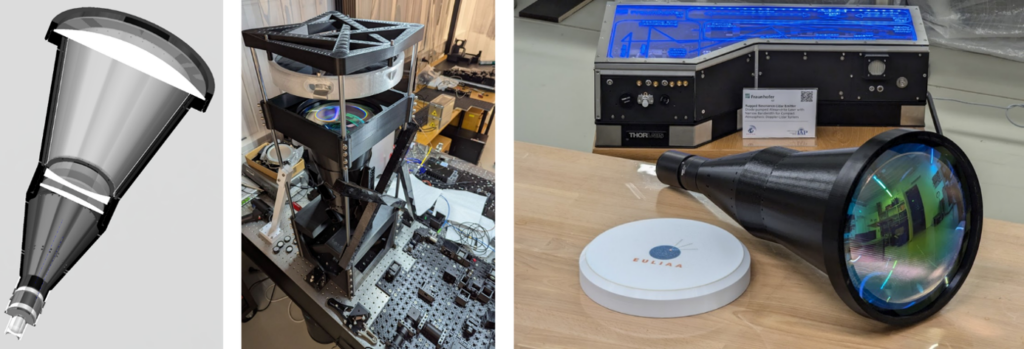
EULIAA uses compact lens telescopes instead of large mirror optics. For the UV system a new design with four BK7 elements was developed to avoid absorption and heating at 386 nm and to improve transmission and wavefront quality.
Key features of the final design:
- 200 mm entrance aperture, ~565 mm length, demagnification ~22:1
- Tolerance analysis confirming acceptable performance with realistic misalignments
- Tolerance analysis confirming acceptable performance with realistic misalignments
- Fully 3D‑printed mechanics with metal distance holders where needed
Two variants of each telescope were built: one for IR (770 nm) and one for UV (386 nm), differing only in lens separation. All telescopes include anti‑seeing measures:
- A plane cover glass with customized coating that reflects most of the solar spectrum while transmitting >95 % at the lidar wavelength, reducing absorbed solar heat by more than a factor of 10.
- A double‑wall telescope tube: sunlight passes a thin inner transparent wall, is absorbed at the outer wall, and a laminar airflow between both walls removes the heat, suppressing turbulence inside the tube.
The telescopes were pre‑aligned on a dedicated test stand using autocollimation, then integrated into the IR lidar and fine‑aligned with atmospheric signals. Measurements show that seeing effects from solar heating are suppressed by about two orders of magnitude; stable measurements are possible as close as 2° from the Sun. The daylight telescope concept has been submitted for patent.