
How the EULIAA Atmospheric Lidar Derives Wind, Temperature and Aerosols
The EULIAA lidars are compact, autonomous active remote‑sensing systems. They measure wind, temperature and aerosols from about 3 km up to the lower mesosphere by emitting short laser pulses into the atmosphere and analysing the very weak light that is scattered back.
At the core of each system is a diode‑pumped Alexandrite laser. It can operate in the infrared (around 770 nm) or, via intra‑cavity frequency doubling, directly in the ultraviolet (around 386 nm). The UV wavelength is placed in a deep Fraunhofer line of the solar spectrum where the natural background is strongly reduced. Together with extremely narrow optical filters in the receiver this makes the system effectively “solar blind” and allows measurements in full daylight.
The laser beam is expanded by compact lens telescopes and transmitted along three fixed lines of sight: one vertical and two tilted by 30° in orthogonal azimuth directions. A scanner couples the transmitter and the common receiver to one telescope at a time. From the Doppler shift along these three lines of sight, the full 3D wind vector can be reconstructed over a large volume, while the vertical profiles of temperature and aerosols are measured simultaneously.
Different scattering signals – different parts of the atmosphere
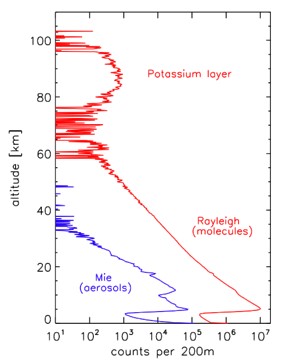
The return signal is a superposition of several scattering processes, each carrying specific information:
- Mie scattering by aerosols and clouds Aerosol and cloud particles produce a narrow, intense Mie peak. This signal:
- reveals aerosol and cloud layers typically between 3 and 30 km,
- is ideal for precise wind measurements from the Doppler shift, because the line is narrow and strong where particles are present, and
- is largely independent of solar background when combined with the narrow filters (“total solar blindness” in the dedicated Mie channel).
- Rayleigh scattering by air molecules Air molecules elastically scatter the laser light. This Rayleigh signal is always present and decreases smoothly with altitude due to the thinner atmosphere. Its spectral width is set by the thermal motion and pressure of the air. It is used to derive:
- temperature profiles (typically 12–50 km, extendable higher), and
- wind at all altitudes from the Doppler shift of the Rayleigh line when the laser and filters are scanned across the spectrum.
By switching polarization in the receiver, EULIAA also measures the depolarization ratio. This allows classification of particle type and phase, for example distinguishing spherical droplets from ice crystals, or identifying Polar Stratospheric Clouds and other climate‑relevant aerosol layers.
- Resonance scattering by metal atoms At selected wavelengths (e.g. potassium near 770 nm, iron near 386 nm) free metal atoms in the mesosphere and lower thermosphere resonantly scatter the laser light. When the laser is locked to such a line, very thin metal layers can be observed up to about 80-120 km. Their Doppler shift and spectral shape provide winds and temperatures in the upper atmosphere and also serve as highly stable absolute frequency references.
From photons to atmospheric data products
The scattered light from the atmosphere is collected by the same telescopes that transmit the laser pulses and is guided to a compact receiver. There, a sequence of matched filters isolates the useful signal from the solar background:
- A high‑transmission interference pre‑filter removes most of the broadband sunlight while transmitting a narrow band around the laser wavelength.
- A temperature‑stabilized solid etalon defines a very narrow transmission peak (≈1 pm), matched to the laser. It provides the basis for Doppler‑Rayleigh measurements and strong daylight rejection.
- A confocal etalon with femtometer‑scale bandwidth separates the narrow Mie peak from the broader Rayleigh spectrum and can be tuned over several gigahertz. This enables simultaneous measurement of Doppler‑Mie winds and Rayleigh/resonance backscatter.
Single‑photon‑sensitive detectors (APDs in the IR, PMTs in the UV) record photon counts as a function of time after each laser pulse. Time directly corresponds to altitude; by integrating over many pulses EULIAA achieves high signal‑to‑noise ratios from the lower free troposphere to well above 40–50 km. Advanced signal‑decomposition methods exploit the known spectral chirp of each laser pulse to increase altitude, spectral and temporal resolution beyond the usual Fourier limit, so that even weak signals above clouds or in clean air can be used.
From these measurements, EULIAA derives:
- 3D wind fields The Doppler shift of the Mie and Rayleigh lines along each line of sight yields line‑of‑sight wind. Combining the three viewing directions provides horizontal and vertical wind components with high resolution. Depending on conditions, Mie winds are routinely retrieved up to ~25–30 km, Rayleigh winds and temperatures up to ~50 km.
- Temperature profiles The Rayleigh backscatter is proportional to air density. Assuming hydrostatic equilibrium and starting from a reference level at high altitude, density is integrated downward to obtain temperature. Because EULIAA can separate molecular and aerosol contributions using the two channels, Rayleigh temperatures can be extended down to the tropopause and, under clear conditions, into the upper troposphere.
- Aerosol and cloud properties The strength and vertical structure of the Mie signal, the Mie/Rayleigh ratio and the depolarization provide profiles of aerosol and cloud backscatter, layer height and type. This includes tropospheric aerosol layers, cirrus, Polar Stratospheric Clouds, noctilucent clouds and anthropogenic aerosol plumes such as rocket exhaust.
By combining Rayleigh, Mie and resonance scattering in a single, compact and autonomous platform, EULIAA closes the critical data gap between about 3 and 50 km altitude and delivers continuous, high‑resolution wind, temperature and aerosol observations for climate monitoring, weather prediction and studies of atmospheric dynamics.