
The first real stress test for the EULIAA technology came when the EULIAA IR lidar left Germany for the Arctic. At the end of October 2025, the complete system was packed into two wheeled transport boxes, shipped by truck over roughly 3,000 km and installed at the Arctic Lidar Observatory for Middle Atmosphere Research (ALOMAR) on Andøya Island, about 300 km north of the Arctic Circle.
The lidar was positioned inside the ALOMAR telescope hall, next to the large RMR lidar telescopes. This arrangement offers wind and snow protection, while the roof hatch of the hall opens to expose the beams to the sky when conditions and air-safety constraints allow. Despite the transport and the move into a new environment, the instrument was operational within a day with no internal realignment of the laser, receiver or telescopes necessary. Standard autonomous operation started within the first week.
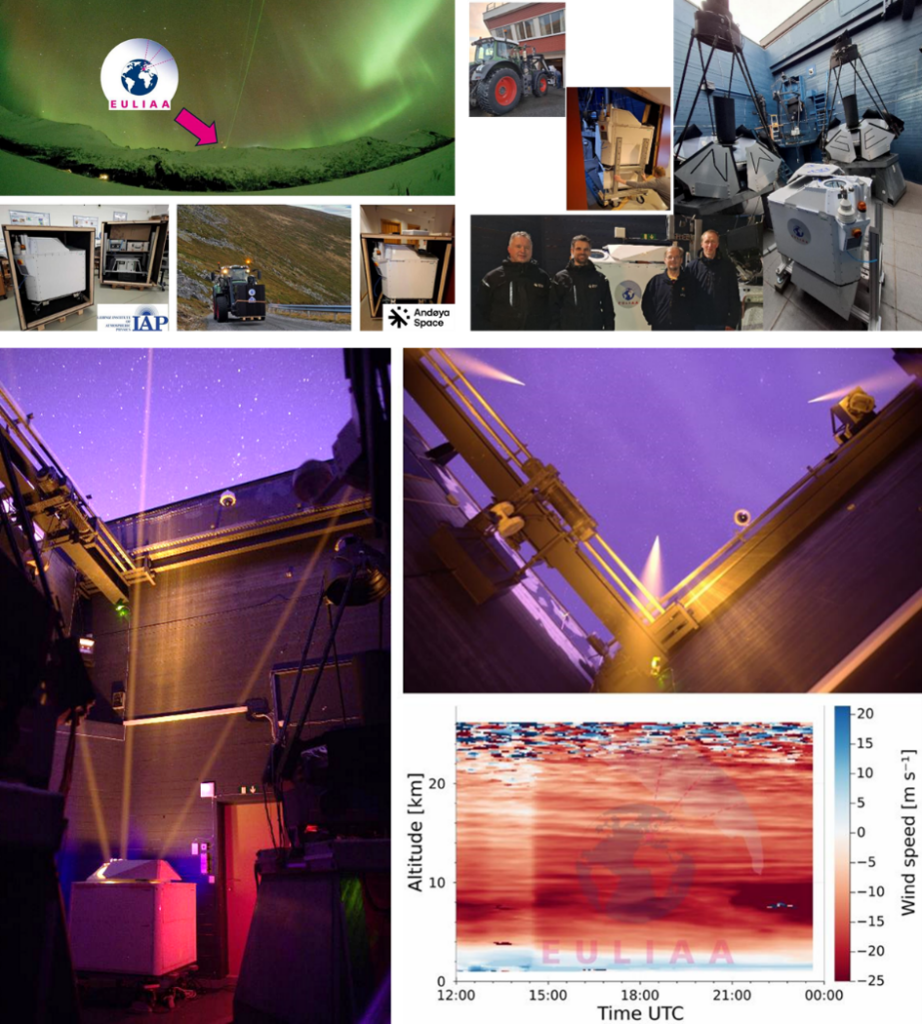
Since then, the system has been running largely “business as usual”. By March 2026 it had accumulated more than four months of autonomous operation in Arctic winter, demonstrating that the compact, 3D‑printed platform and the thermal design can handle temperatures well below -10 °C. When the hatch is open, the instrument routinely retrieves:
- aerosol and cloud backscatter and winds from Mie scattering up to roughly 25–30 km,
- Rayleigh temperatures up to about 50 km, and
- metal layer signals around 80–100 km when tuned to the potassium resonance.
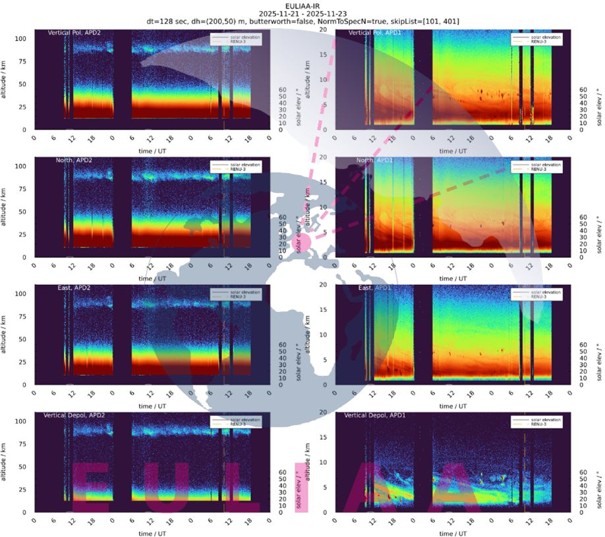
Andøya also provided the first operational test in a spaceflight context. During the NASA GHOST student mission in November 2025, the lidar delivered real-time wind profiles from 3-30 km right up to launch time, demonstrating the potential of this kind of system to support launch operations. Later, during a sounding-rocket campaign, the lidar tracked the aerosol plume from the rocket exhaust through the atmosphere to more than 40 km altitude and over several hours. These measurements, presented at an ESA Sustainability Workshop in Paris and the ESA Symposium in Trondheim, sparked interest in using such lidars to monitor rocket emissions and to improve launch safety.
A rich set of comparisons with the MAARSY wind radar, a 1064 nm aerosol profiler, local radiosondes and ECMWF output shows excellent consistency in wind and temperature, while the lidar again provides higher resolution and extended altitude coverage. The Arctic campaign therefore confirms not only the robustness of the hardware but also the scientific value of the measurements in a region that is critical for climate studies.