The Observatoire de Haute-Provence in southern France is a well-established site for atmospheric lidar and long-term monitoring, with extensive NDACC and EARLINET heritage. It was chosen as the first deployment site for the new UV version of the EULIAA lidar, which operates in a Fraunhofer line around 386 nm.
After a short test phase at IAP, the first UV system was transported in April 2026 by truck to OHP and installed on a concrete platform next to the existing lidar buildings at the Gérard‑Mégie station. Once again, the instrument achieved “first light” on the evening of arrival, with no realignment required after transport.
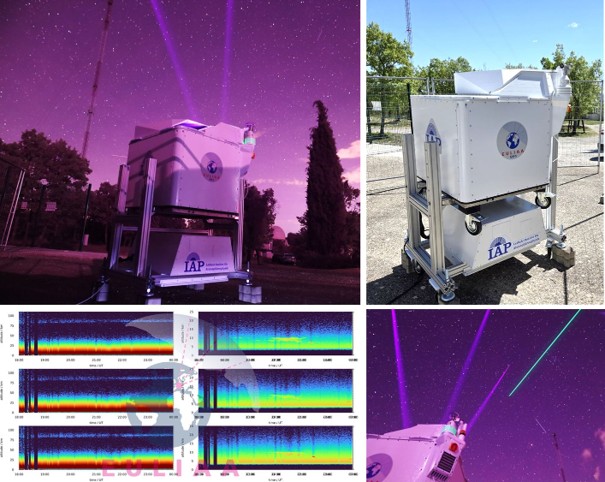
At OHP the UV lidar exploits two key advantages: the stronger Rayleigh signal and much deeper solar Fraunhofer line at 386 nm. Combined with the newly developed UV telescopes, high-damage-threshold optics and narrow filters, this makes the system effectively solar-blind for both Mie and Rayleigh channels. The instrument can therefore provide continuous profiles from the lower troposphere to around 50 km altitude and even measured the iron layer in the mesosphere (80-90 km), under both day- and night-time conditions.
The Mediterranean climate with many clear nights and frequent calm periods is ideal for validating the UV concept and for detailed comparisons with the existing OHP lidars and auxiliary instruments. The mediterranean summer temperatures > 40 °C and occasionally thunderstorms were mastered by the lidar instrument as well.
The campaign focuses on:
- testing the daylight performance and stability of the UV emitter and filters,
- retrieving winds, temperatures and aerosol profiles up to the middle atmosphere, and
- quantifying the added value of UV Rayleigh measurements compared to traditional systems, especially in the 20–50 km range.
By embedding the UV lidar in a mature observatory with well-characterized instruments and long-time series, this campaign provides a robust reference for the performance of the new subsystems and their readiness for broader deployment.