
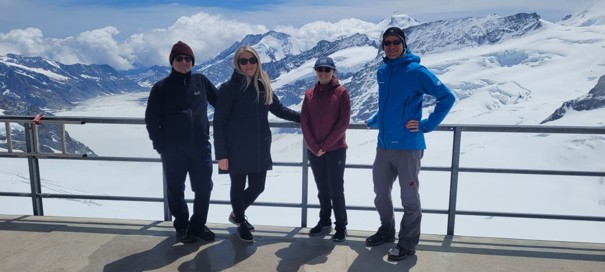
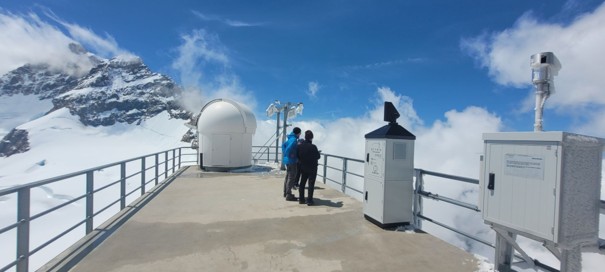
The high-altitude campaign at Jungfraujoch represents the most demanding test for the UV lidar systems in terms of logistics and environment. The Sphinx Observatory, at 3,571 m above sea level in the Swiss Alps, is exposed to extreme conditions: hoarfrost, heavy snow, frequent icing and wind gusts that can exceed 200–250 km/h during winter storms.
The EULIAA UV‑2 lidar will be flown by helicopter to the MeteoTerrace (Level 1) of the Sphinx Observatory. To make this possible, the standard lidar frame has been adapted into a special transport and mounting structure that can be safely installed on the terrace.
The campaign, scheduled to start in early July 2026, aims to run the UV lidar for around three months under these harsh conditions. The goals are to:
- demonstrate fully autonomous operation of a UV EULIAA system at a remote, high-mountain site,
- verify that the thermal control, housing and safety systems remain reliable under strong winds, icing and low temperatures,
- obtain high‑resolution wind, temperature and aerosol profiles above the Alps, and
- prepare for future dual‑site operation together with the MeteoSwiss reference station at Payerne as a first step towards a lidar array.
By combining the mountain campaign with parallel measurements at Payerne, the project will be able to test two UV systems in a quasi-array configuration and to assess how such instruments could be integrated into a future European network covering very different altitudes and climates.